

Part 2: Mitochondria
What this Module is about:
This is the overview of the electron transport chain. Electrons enter and get passed along. As they move, protons get pumped into the space between the membranes. That stored charge is what ATP synthase uses. ATP is not made yet at this stage. Pressure is being built for the turbine.
Lesson Goals:
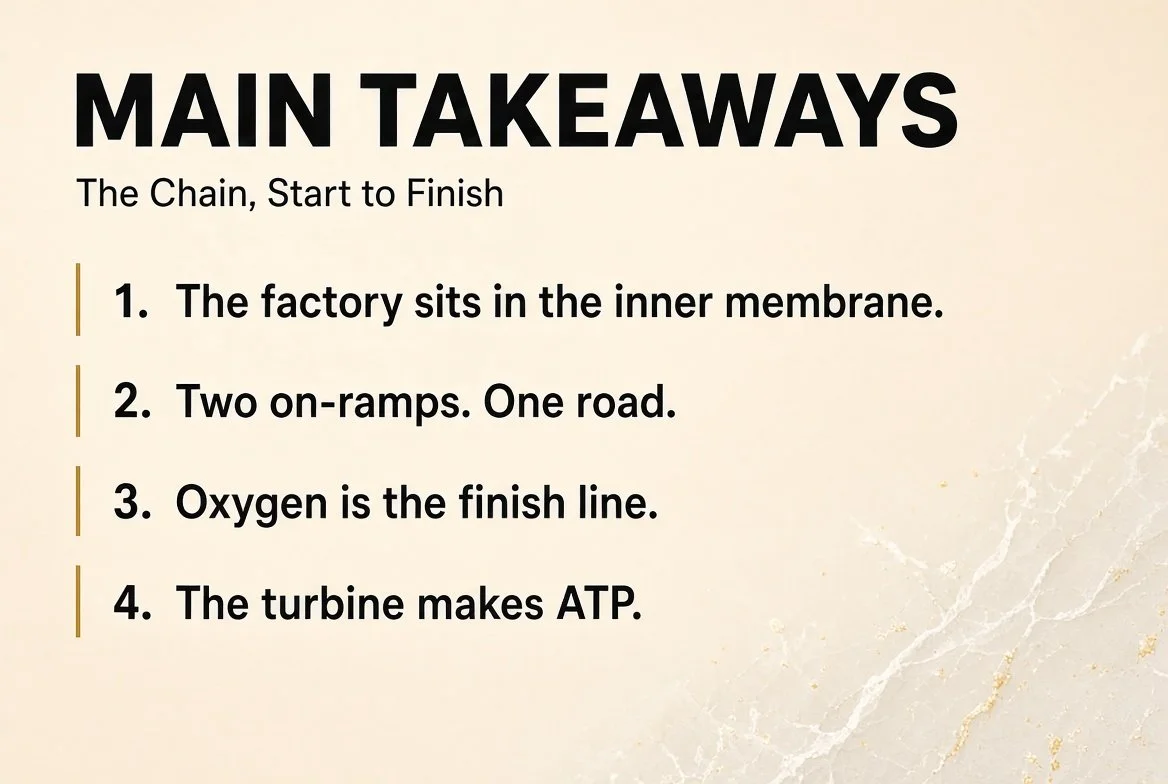
See the chain as one road in the inner membrane
Know the two on-ramps: NADH at Complex I, FADH2 at Complex II
Understand why oxygen belongs in an energy course
Know ATP is made at Complex V, not in I through IV
What To Do Now:
Don’t memorize every complex
Keep the map: two on-ramps, one road, oxygen at the end, turbine making ATP
Next modules walk the chain one station at a time
-
Moving electrons frees a little energy. The complexes use that to push protons out. More protons on one side than the other is stored charge, like a battery. Without that pile, ATP synthase has nothing to turn. Electrons are the workers on the line. Protons are how the work gets stored instead of wasted as heat.
-
NADH unloads at Complex I. FADH2 unloads at Complex II. Complex II does not pump protons the same way, which is why the two entries feel different. After that they share the same shuttle: CoQ10 to Complex III, cytochrome c to Complex IV. Complex IV hands electrons to oxygen. Oxygen, electrons, and protons become water. No finish line, no flow. No flow, less ATP.
-
Electrons back up. The proton pile gets weaker or sloppier. You get less ATP, and you can get more leftover exhaust. If Complex I is off, the NADH on-ramp is short. If Complex IV lags, oxygen cannot finish the job. A leaky proton gradient means you built the charge and lost it as heat. The chain is only as strong as the slowest station.